-
Besides consuming data streams, DOS Network can connect smart contracts with any external API / data by utilizing DOSOnChainSDK contract for each supported chain. For each data request or VRF randomness request, 20 DOS token is needed (the number may change depending on usage cost).
-
In the calling contract's constructor, simply setup by calling
super.DOSSetup(). -
Sending several DOS tokens as fees into the calling contract. The fees can be reclaimed by contract owner by calling
DOSRefund().
contract Example is DOSOnChainSDK {
  // ...
  constructor() public {
    // @dev: setup and then transfer DOS tokens into deployed contract as oracle fees.
    // Unused fees can be reclaimed by calling DOSRefund() in the SDK.
    super.DOSSetup();
  }
  // ...
}-
Smart contract requests for external data by calling
DOSQuery()function. The whole process is an asynchronous one - i.e. it merely returns a uniquequeryIdthat caller caches for bookkeeping and future identification, with the real response coming back through the__callback__()function. -
The response data will be backfilled through the
__callback__function along with correspondingqueryId. Instead of backfilling the whole raw response we're using selector expression to filterjsonandxml/htmlformated response, developers are able to specify interesting data fields inDOSQuery()function. -
Example usage:
function DOSQuery(uint timeout, string memory dataSource, string memory selector):
timeout: An estimated timeout in seconds specified by the caller, e.g.30. Response is not guaranteed if client side processing time exceeds this value.dataSource: Path to the data source specified by caller.selector: Aselector expressionprovided by caller to filter out specific data fields out of the raw response, with the response data format (json, xml, or more) to be identified from the selector expression. Check the selector expression part for details.- Example usage:
contract Example is DOSOnChainSDK {
    mapping(uint => bool) private _valid_queries;
    ...
    function CoinbaseEthPriceFeed() public {
        // Returns a unique queryId that caller caches for future verification
        uint queryId = DOSQuery(30, "https://api.coinbase.com/v2/prices/ETH-USD/spot", "$.data.amount");
        _valid_queries[queryId] = true;
        ...
    }
    ...
}* Note that the caller must override `__callback__` function to receive and process the response. A user-defined event may be added to notify the Dapp frontend that the response is ready.
function __callback__(uint queryId, bytes calldata result):
queryId: A uniquequeryIdreturned byDOSQuery()to differenciate parallel responses.result: Corresponding response inbytes.- Example usage:
function __callback__(uint queryId, bytes calldata result) external auth {
    // Check whether @queryId corresponds to a previous cached one
    require(_valid_queries[queryId], "Err-resp-with-invalid-queryId");

    // Deal with result
    ...
    delete _valid_queries[queryId];
}- We also provide utility functions for developers to easily process
string / bytes:
  library StringUtils {
      function subStr(string memory a, uint start, uint len) internal pure returns(string memory);
      function subStr(string memory a, uint start) internal pure returns(string memory);
      function subStr(bytes memory a, uint start, uint len) internal pure returns(bytes memory);
      function subStr(bytes memory a, uint start) internal pure returns(bytes memory);
      function indexOf(string memory haystack, string memory needle) internal pure returns(uint);
      function indexOf(bytes memory haystack, bytes memory needle) internal pure returns(uint);
      function count(string memory str, string memory delimiter) internal pure returns(uint);
      function split(string memory str, string memory delimiter) internal pure returns(string[] memory);
      function split(bytes memory str, bytes memory delimiter) internal pure returns(bytes[] memory);
      function strConcat(string memory a, string memory b) internal pure returns(string memory);
      function bytesConcat(bytes memory a, bytes memory b) internal pure returns(bytes memory);
      function strCompare(string memory a, string memory b) internal pure returns(int);
      function bytesCompare(bytes memory a, bytes memory b) internal pure returns(int);
      function strEqual(string memory a, string memory b) internal pure returns(bool);
      function bytesEqual(bytes memory a, bytes memory b) internal pure returns(bool);

      function uint2Str(uint x) internal pure returns(string memory);
      function uint2HexStr(uint x) internal pure returns(string memory);
      function addr2Str(address x) internal pure returns(string memory);
      function str2Addr(string memory a) internal pure returns(address);
      function str2Uint(string memory a) internal pure returns(uint);
      function hexStr2Uint(string memory a) internal pure returns(uint);
      function byte2Uint(byte b) internal pure returns(uint);
      function hexByte2Uint(byte b) internal pure returns(uint);
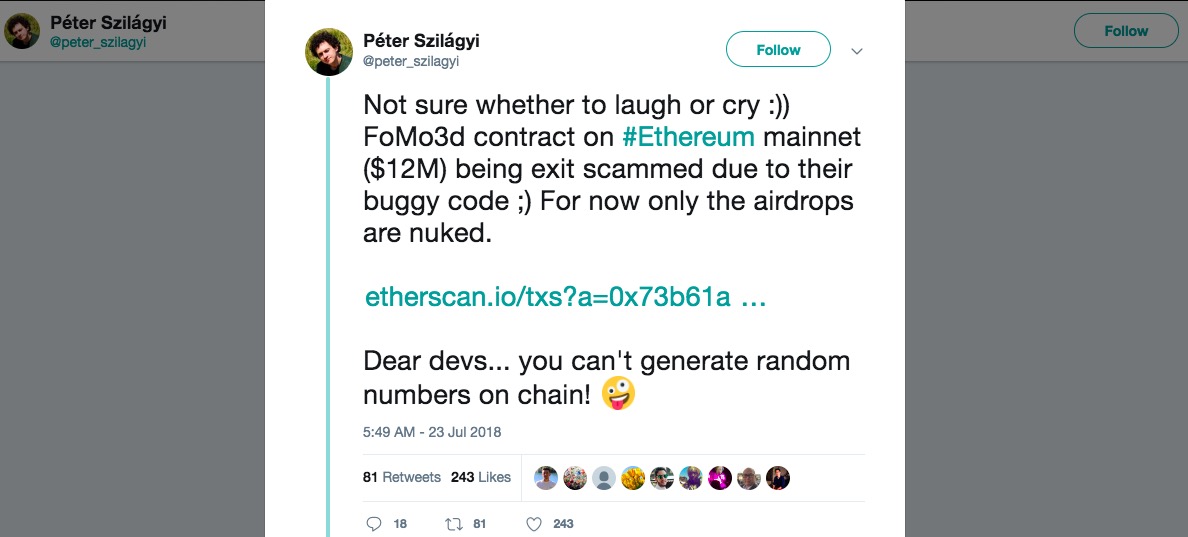
}- Randomness is particularly important for many Dapps and games, however, it's impossible to generate a secure and unpredictable random number in pure deterministic environment:
- DOS Network is providing a provably secure, unstoppable and unpredictable random source for on-chain smart contracts to use. For technical details and cryptographic proofs please check our whitepaper.
function DOSRandom(uint seed) returns (uint):
seed: An optional random seed provided by caller to get more entropy. The generated random number is secure and unpredictable in safe mode even without providing thisseed.- Example usage:
function requestSafeRandom() public {
    uint requestId = DOSRandom(now);
    _valid[requestId] = true;
    emit RandomRequested(requestId);
}function __callback__(uint requestId, uint generatedRandom) external:
requestId: A uniquerequestIdreturned byDOSRandom()to process parallelly generated random numbers.generatedRandom: Generated secure random number for the specificrequestId.- Example usage:
modifier auth(uint id) {
    // Exclude malicious callback responses.
    require(msg.sender == fromDOSProxyContract(),
            "Unauthenticated response from non-DOS.");
    // Check whether id mapps to a previously requested one.
    require(_valid[id], "Response with invalid request id!");
    _;
}

function __callback__(uint requestId, uint generatedRandom)
    external
    auth(requestId)
{
    emit RandomGenerated(generatedRandom);
    delete _valid[requestId];

    // Deal with generated random number
    random = generatedRandom;
    ...
}