| permalink | plugins |
|---|---|
| sidebarDepth | |
| sidebar | auto |
| title | Plugins |
Uses AI to analyze test failures and provide insights
This plugin analyzes failed tests using AI to provide detailed explanations and group similar failures. When enabled with --ai flag, it generates reports after test execution.
// in codecept.conf.js
exports.config = {
  plugins: {
    analyze: {
      enabled: true,
      clusterize: 5,
      analyze: 2,
      vision: false
    }
  }
}clusterize(number) - minimum number of failures to trigger clustering analysis. Default: 5analyze(number) - maximum number of individual test failures to analyze in detail. Default: 2vision(boolean) - enables visual analysis of test screenshots. Default: falsecategories(array) - list of failure categories for classification. Defaults to:- Browser connection error / browser crash
- Network errors (server error, timeout, etc)
- HTML / page elements (not found, not visible, etc)
- Navigation errors (404, etc)
- Code errors (syntax error, JS errors, etc)
- Library & framework errors
- Data errors (password incorrect, invalid format, etc)
- Assertion failures
- Other errors
prompts(object) - customize AI prompts for analysisclusterize- prompt for clustering analysisanalyze- prompt for individual test analysis
- Groups similar failures when number of failures >= clusterize value
- Provides detailed analysis of individual failures
- Analyzes screenshots if vision=true and screenshots are available
- Classifies failures into predefined categories
- Suggests possible causes and solutions
configObject Plugin configuration (optional, default{})
Returns void
Logs user in for the first test and reuses session for next tests. Works by saving cookies into memory or file. If a session expires automatically logs in again.
For better development experience cookies can be saved into file, so a session can be reused while writing tests.
- Enable this plugin and configure as described below
- Define user session names (example:
user,editor,admin, etc). - Define how users are logged in and how to check that user is logged in
- Use
loginobject inside your tests to log in:
// inside a test file
// use login to inject auto-login function
Feature('Login');

Before(({ login }) => {
   login('user'); // login using user session
});

// Alternatively log in for one scenario.
Scenario('log me in', ( { I, login } ) => {
   login('admin');
   I.see('I am logged in');
});saveToFile(default: false) - save cookies to file. Allows to reuse session between execution.inject(default:login) - name of the login function to useusers- an array containing different session names and functions to:login- sign in into the systemcheck- check that user is logged infetch- to get current cookies (by defaultI.grabCookie())restore- to set cookies (by defaultI.amOnPage('/'); I.setCookie(cookie))
restoremethod is executed. It should open a page and set credentials.checkmethod is executed. It should reload a page (so cookies are applied) and check that this page belongs to logged-in user. When you pass the second argssession, you could perform the validation using passed session.- If
restoreandcheckwere not successful,loginis executed loginshould fill in login form- After successful login,
fetchis executed to save cookies into memory or file.
auth: {
  enabled: true,
  saveToFile: true,
  inject: 'login',
  users: {
    admin: {
      // loginAdmin function is defined in `steps_file.js`
      login: (I) => I.loginAdmin(),
      // if we see `Admin` on page, we assume we are logged in
      check: (I) => {
         I.amOnPage('/');
         I.see('Admin');
      }
    }
  }
}auth: {
enabled: true,
saveToFile: true,
inject: 'loginAs', // use `loginAs` instead of login
users: {
user: {
login: (I) => {
I.amOnPage('/login');
I.fillField('email', 'user@site.com');
I.fillField('password', '123456');
I.click('Login');
},
check: (I) => {
I.amOnPage('/');
I.see('User', '.navbar');
},
},
admin: {
login: (I) => {
I.amOnPage('/login');
I.fillField('email', 'admin@site.com');
I.fillField('password', '123456');
I.click('Login');
},
check: (I) => {
I.amOnPage('/');
I.see('Admin', '.navbar');
},
},
}
}If you decide to keep cookies between tests you don't need to save/retrieve cookies between tests.
But you need to login once work until session expires.
For this case, disable fetch and restore methods.
helpers: {
   WebDriver: {
     // config goes here
     keepCookies: true; // keep cookies for all tests
   }
},
plugins: {
   auth: {
     users: {
       admin: {
         login: (I) => {
           I.amOnPage('/login');
           I.fillField('email', 'admin@site.com');
           I.fillField('password', '123456');
           I.click('Login');
         },
         check: (I) => {
           I.amOnPage('/dashboard');
           I.see('Admin', '.navbar');
         },
         fetch: () => {}, // empty function
         restore: () => {}, // empty funciton
       }
    }
  }
}If your session is stored in local storage instead of cookies you still can obtain sessions.
plugins: {
   auth: {
    admin: {
      login: (I) => I.loginAsAdmin(),
      check: (I) => I.see('Admin', '.navbar'),
      fetch: (I) => {
        return I.executeScript(() => localStorage.getItem('session_id'));
      },
      restore: (I, session) => {
        I.amOnPage('/');
        I.executeScript((session) => localStorage.setItem('session_id', session), session);
      },
    }
  }
}If you use async functions in the auth plugin, login function should be used with await keyword.
auth: {
  enabled: true,
  saveToFile: true,
  inject: 'login',
  users: {
    admin: {
      login: async (I) => {  // If you use async function in the auth plugin
         const phrase = await I.grabTextFrom('#phrase')
         I.fillField('username', 'admin'),
         I.fillField('password', 'password')
         I.fillField('phrase', phrase)
      },
      check: (I) => {
         I.amOnPage('/');
         I.see('Admin');
      },
    }
  }
}Scenario('login', async ( {I, login} ) => {
await login('admin') // you should use `await`
})Instead of asserting on page elements for the current user in check, you can use the session you saved in fetch
auth: {
  enabled: true,
  saveToFile: true,
  inject: 'login',
  users: {
    admin: {
      login: async (I) => {  // If you use async function in the auth plugin
         const phrase = await I.grabTextFrom('#phrase')
         I.fillField('username', 'admin'),
         I.fillField('password', 'password')
         I.fillField('phrase', phrase)
      },
      check: (I, session) => {
         // Throwing an error in `check` will make CodeceptJS perform the login step for the user
         if (session.profile.email !== the.email.you.expect@some-mail.com) {
              throw new Error ('Wrong user signed in');
        }
      },
    }
  }
}Scenario('login', async ( {I, login} ) => {
await login('admin') // you should use `await`
})config
Sometimes it takes some time for a page to respond to user's actions. Depending on app's performance this can be either slow or fast.
For instance, if you click a button and nothing happens - probably JS event is not attached to this button yet Also, if you fill field and input validation doesn't accept your input - maybe because you typed value too fast.
This plugin allows to slow down tests execution when a test running too fast. It puts a tiny delay for before and after action commands.
Commands affected (by default):
clickfillFieldcheckOptionpressKeydoubleClickrightClick
plugins: {
   autoDelay: {
     enabled: true
   }
}
Possible config options:
methods: list of affected commands. Can be overriddendelayBefore: put a delay before a command. 100ms by defaultdelayAfter: put a delay after a command. 200ms by default
config
Consolidates JSON reports from multiple workers into a single HTML report
config
Dumps code coverage from Playwright/Puppeteer after every test.
plugins: {
   coverage: {
     enabled: true,
     debug: true,
     name: 'CodeceptJS Coverage Report',
     outputDir: 'output/coverage'
   }
}
Possible config options, More could be found at monocart-coverage-reports
debug: debug info. By default, false.name: coverage report name.outputDir: path to coverage report.sourceFilter: filter the source files.sourcePath: option to resolve a custom path.
config
Creates a custom locator by using special attributes in HTML.
If you have a convention to use data-test-id or data-qa attributes to mark active elements for e2e tests,
you can enable this plugin to simplify matching elements with these attributes:
// replace this:
I.click({ css: '[data-test-id=register_button]');
// with this:
I.click('$register_button');
This plugin will create a valid XPath locator for you.
enabled(default:false) should a locator be enabledprefix(default:$) sets a prefix for a custom locator.attribute(default:data-test-id) to set an attribute to be matched.strategy(default:xpath) actual locator strategy to use in query (cssorxpath).showActual(default: false) show in the output actually produced XPath or CSS locator. By default shows custom locator value.
Using data-test attribute with $ prefix:
// in codecept.conf.js
plugins: {
 customLocator: {
   enabled: true,
   attribute: 'data-test'
 }
}
In a test:
I.seeElement('$user'); // matches => [data-test=user]
I.click('$sign-up'); // matches => [data-test=sign-up]
Using data-qa attribute with = prefix:
// in codecept.conf.js
plugins: {
 customLocator: {
   enabled: true,
   prefix: '=',
   attribute: 'data-qa'
 }
}
In a test:
I.seeElement('=user'); // matches => [data-qa=user]
I.click('=sign-up'); // matches => [data-qa=sign-up]
Using data-qa OR data-test attribute with = prefix:
// in codecept.conf.js
plugins: {
 customLocator: {
   enabled: true,
   prefix: '=',
   attribute: ['data-qa', 'data-test'],
   strategy: 'xpath'
 }
}
In a test:
I.seeElement('=user'); // matches => //*[@data-qa=user or @data-test=user]
I.click('=sign-up'); // matches => //*[data-qa=sign-up or @data-test=sign-up]
// in codecept.conf.js
plugins: {
customLocator: {
enabled: true,
prefix: '=',
attribute: ['data-qa', 'data-test'],
strategy: 'css'
}
}In a test:
I.seeElement('=user'); // matches => [data-qa=user],[data-test=user]
I.click('=sign-up'); // matches => [data-qa=sign-up],[data-test=sign-up]config
Sample custom reporter for CodeceptJS.
config
Enhanced retryFailedStep plugin that coordinates with other retry mechanisms
This plugin provides step-level retries and coordinates with global retry settings to avoid conflicts and provide predictable behavior.
config
Self-healing tests with AI.
Read more about heaking in Self-Healing Tests
plugins: {
  heal: {
   enabled: true,
  }
}
More config options are available:
healLimit- how many steps can be healed in a single test (default: 2)
config(optional, default{})
Collects information from web page after each failed test and adds it to the test as an artifact.
It is suggested to enable this plugin if you run tests on CI and you need to debug failed tests.
This plugin can be paired with analyze plugin to provide more context.
It collects URL, HTML errors (by classes), and browser logs.
Enable this plugin in config:
plugins: {
 pageInfo: {
  enabled: true,
}
Additional config options:
errorClasses- list of classes to search for errors (default:['error', 'warning', 'alert', 'danger'])browserLogs- list of types of errors to search for in browser logs (default:['error'])
config(optional, default{})
Automatically launches interactive pause when a test fails.
Useful for debugging flaky tests on local environment. Add this plugin to config file:
plugins: {
  pauseOnFail: {},
}
Unlike other plugins, pauseOnFail is not recommended to be enabled by default.
Enable it manually on each run via -p option:
npx codeceptjs run -p pauseOnFail
TypeScript: Explicitly type reportData arrays as any[] to avoid 'never' errors
Retries each failed step in a test.
Add this plugin to config file:
plugins: {
    retryFailedStep: {
       enabled: true
    }
}
Run tests with plugin enabled:
npx codeceptjs run --plugins retryFailedStep
retries- number of retries (by default 3),when- function, when to perform a retry (accepts error as parameter)factor- The exponential factor to use. Default is 1.5.minTimeout- The number of milliseconds before starting the first retry. Default is 1000.maxTimeout- The maximum number of milliseconds between two retries. Default is Infinity.randomize- Randomizes the timeouts by multiplying with a factor from 1 to 2. Default is false.defaultIgnoredSteps- an array of steps to be ignored for retry. Includes:amOnPagewait*send*execute*run*have*
ignoredSteps- an array for custom steps to ignore on retry. Use it to append custom steps to ignored list. You can use step names or step prefixes ending with*. As such,wait*will match all steps starting withwait. To append your own steps to ignore list - copy and paste a default steps list. Regexp values are accepted as well.
plugins: {
    retryFailedStep: {
        enabled: true,
        ignoredSteps: [
          'scroll*', // ignore all scroll steps
          /Cookie/, // ignore all steps with a Cookie in it (by regexp)
        ]
    }
}This plugin can be disabled per test. In this case you will need to stet I.retry() to all flaky steps:
Use scenario configuration to disable plugin for a test
Scenario('scenario tite', { disableRetryFailedStep: true }, () => {
   // test goes here
})config
Safely serialize data to JSON, handling circular references
data
Creates screenshot on failure. Screenshot is saved into output directory.
Initially this functionality was part of corresponding helper but has been moved into plugin since 1.4
This plugin is enabled by default.
Configuration can either be taken from a corresponding helper (deprecated) or a from plugin config (recommended).
plugins: {
   screenshotOnFail: {
     enabled: true
   }
}
Possible config options:
uniqueScreenshotNames: use unique names for screenshot. Default: false.fullPageScreenshots: make full page screenshots. Default: false.
config
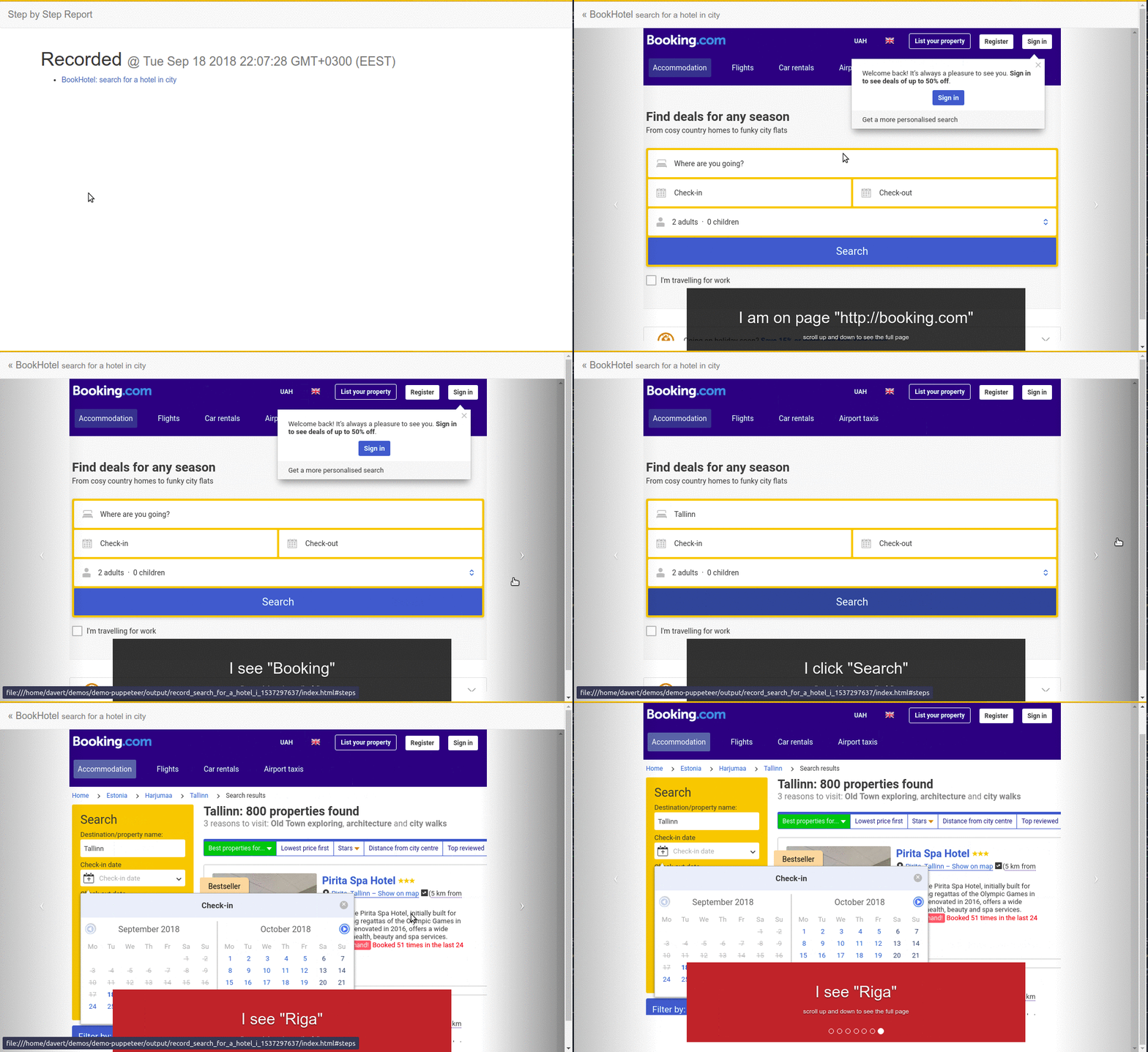
Generates step by step report for a test. After each step in a test a screenshot is created. After test executed screenshots are combined into slideshow. By default, reports are generated only for failed tests.
Run tests with plugin enabled:
npx codeceptjs run --plugins stepByStepReport
"plugins": {
   "stepByStepReport": {
     "enabled": true
   }
}
Possible config options:
deleteSuccessful: do not save screenshots for successfully executed tests. Default: true.animateSlides: should animation for slides to be used. Default: true.ignoreSteps: steps to ignore in report. Array of RegExps is expected. Recommended to skipgrab*andwait*steps.fullPageScreenshots: should full page screenshots be used. Default: false.output: a directory where reports should be stored. Default:output.screenshotsForAllureReport: If Allure plugin is enabled this plugin attaches each saved screenshot to allure report. Default: false.- `disableScreenshotOnFail : Disables the capturing of screeshots after the failed step. Default: true.
configany
Set timeout for test steps globally.
Add this plugin to config file:
plugins: {
    stepTimeout: {
       enabled: true
    }
}
Run tests with plugin enabled:
npx codeceptjs run --plugins stepTimeout
-
timeout- global step timeout, default 150 seconds -
overrideStepLimits- whether to use timeouts set in plugin config to override step timeouts set in code with I.limitTime(x).action(...), default false -
noTimeoutSteps- an array of steps with no timeout. Default:amOnPagewait*
you could set your own noTimeoutSteps which would replace the default one.
-
customTimeoutSteps- an array of step actions with custom timeout. Use it to override or extend noTimeoutSteps. You can use step names or step prefixes ending with*. As such,wait*will match all steps starting withwait.
plugins: {
    stepTimeout: {
        enabled: true,
        overrideStepLimits: true,
        noTimeoutSteps: [
          'scroll*', // ignore all scroll steps
          /Cookie/, // ignore all steps with a Cookie in it (by regexp)
        ],
        customTimeoutSteps: [
          ['myFlakyStep*', 1],
          ['scrollWhichRequiresTimeout', 5],
        ]
    }
}config
Automatically captures steps as subtitle, and saves it as an artifact when a video is found for a failed test
plugins: {
 subtitles: {
   enabled: true
 }
}