Given a circular array circ of integers represented by nums, find the maximum possible sum of a non-empty subarray of circ.
Here, a circular array means the end of the array connects to the beginning of the array. (Formally, circ[i] = nums[i] when 0 <= i < nums.length, and circ[i+nums.length] = circ[i] when i >= 0.)
Also, a subarray may only include each element of the fixed buffer nums at most once. (Formally, for a subarray circ[i], circ[i+1], ..., circ[j], there does not exist i <= k1, k2 <= j with k1 % nums.length = k2 % nums.length.)
Example 1:
Input: nums = [1,-2,3,-2]
Output: 3
Explanation: Subarray [3] has maximum sum 3
Example 2:
Input: nums = [5,-3,5]
Output: 10
Explanation: Subarray [5,5] has maximum sum 5 + 5 = 10
Example 3:
Input: nums = [3,-1,2,-1]
Output: 4
Explanation: Subarray [2,-1,3] has maximum sum 2 + (-1) + 3 = 4
Example 4:
Input: nums = [3,-2,2,-3]
Output: 3
Explanation: Subarray [3] and [3,-2,2] both have maximum sum 3
Example 5:
Input: nums = [-2,-3,-1]
Output: -1
Explanation: Subarray [-1] has maximum sum -1
Note:
-30000 <= nums[i] <= 300001 <= nums.length <= 30000
[Array]
Hint 1
For those of you who are familiar with the Kadane's algorithm, think in terms of that. For the newbies, Kadane's algorithm is used to finding the maximum sum subarray from a given array. This problem is a twist on that idea and it is advisable to read up on that algorithm first before starting this problem. Unless you already have a great algorithm brewing up in your mind in which case, go right ahead!Hint 2
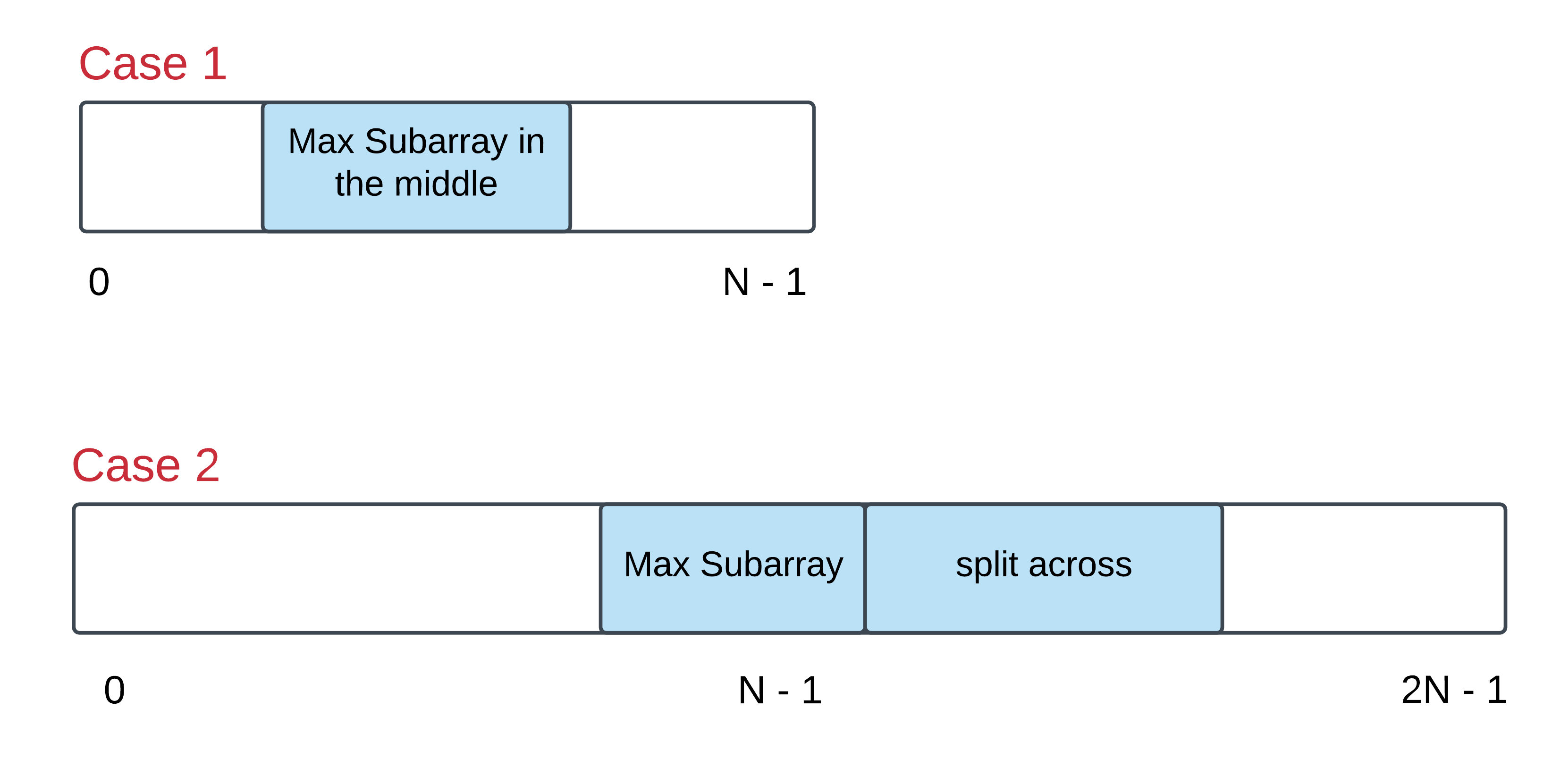
What is an alternate way of representing a circular array so that it appears to be a straight array? Essentially, there are two cases of this problem that we need to take care of. Let's look at the figure below to understand those two cases: