- How to setup logback for slf4j
- See alternaive: log4j2 doc doc
- API: slf4j
- Implementation: logback
Appender
- Official docs
- Store app log config at
src/main/resources/logback.xml
- Store Test log configuration at
src/test/resources/logback-test.xml
<configuration>

    <appender name="STDOUT" class="ch.qos.logback.core.ConsoleAppender">
        <encoder>
            <pattern>%d{HH:mm:ss.SSS} [%thread] [%-5level] %logger{24} - %msg%n</pattern>
        </encoder>
    </appender>

    <logger name="com.mystuff" level="DEBUG"/>

    <logger name="ch.qos.logback" level="WARN"/>
    <logger name="io.netty" level="INFO"/>
    <logger name="io.netty.buffer" level="WARN"/>
    <logger name="io.netty.channel" level="WARN"/>

    <root level="debug">
        <appender-ref ref="STDOUT"/>
    </root>

</configuration>dependencies {
// -- For the API
implementation("org.slf4j:slf4j-api:2.0.16") // or latest
// -- For the implementation
implementation("ch.qos.logback:logback-classic:1.5.16") // or latest
implementation("ch.qos.logback:logback-core:1.5.16") // or latest
implementation("ch.qos.logback:logback-access:1.5.16") // or latest
// -- To forward other log statements (logging bridge)
// -- See https://logging.apache.org/log4j/2.x/faq.html#missing_core
// -- See https://www.slf4j.org/legacy.html
implementation("org.apache.logging.log4j:log4j-to-slf4j:2.19.0") // log4j2 api to slf4j api
implementation("org.slf4j:jcl-over-slf4j:2.0.5") // apache commons logging to slf4j
implementation("org.slf4j:jul-to-slf4j:2.0.5") // java.util.logging to slf4j
implementation("org.slf4j:log4j-over-slf4j:2.0.5") // legacy log4j to slf4j
...
}
configurations.all {
// -- Exclude conflicting/redundant jars
exclude(group = "commons-logging", module = "commons-logging") // legacy
exclude(group = "jboss-logging", module = "org.jboss.logging") // legacy
exclude(group = "log4j", module = "log4j") // legacy
exclude(group = "org.apache.logging.log4j", module = "log4j-core") // log4j2 impl
exclude(group = "org.apache.logging.log4j", module = "log4j-jcl") // apache commons logging to log4j2 impl
exclude(group = "org.apache.logging.log4j", module = "log4j-jul") // java.util.logging to log4j2 impl
exclude(group = "org.apache.logging.log4j", module = "log4j-slf4j-impl") // slf4j to log4j2 impl
exclude(group = "org.slf4j", module = "slf4j-jcl") // slf4j to apache commons logging
exclude(group = "org.slf4j", module = "slf4j-jdk14") // slf4j to java.util.logging
exclude(group = "org.slf4j", module = "slf4j-log4j12") // slf4j to old 1.x log4j api
exclude(group = "org.slf4j", module = "slf4j-nop") // slf4j to nowhere
exclude(group = "org.slf4j", module = "slf4j-reload4j") // slf4j to reload4j's impl of legacy log4j
exclude(group = "org.slf4j", module = "slf4j-simple") // slf4j to stderr
exclude(group = "org.springframework.boot", module = "spring-boot-starter-log4j2")
...
}import org.slf4j.Logger;
import org.slf4j.LoggerFactory;
...
/**
* <brief description of purpose>
*/
public final class SomeClass {
private static final Logger LOG = LoggerFactory.getLogger(SomeClass.class);
...
}
- Lombok's
@Slf4j annotation does the same
- tradeoff: less code, slower builds
- https://docs.spring.io/spring-boot/docs/3.0.0/reference/html/features.html#features.logging
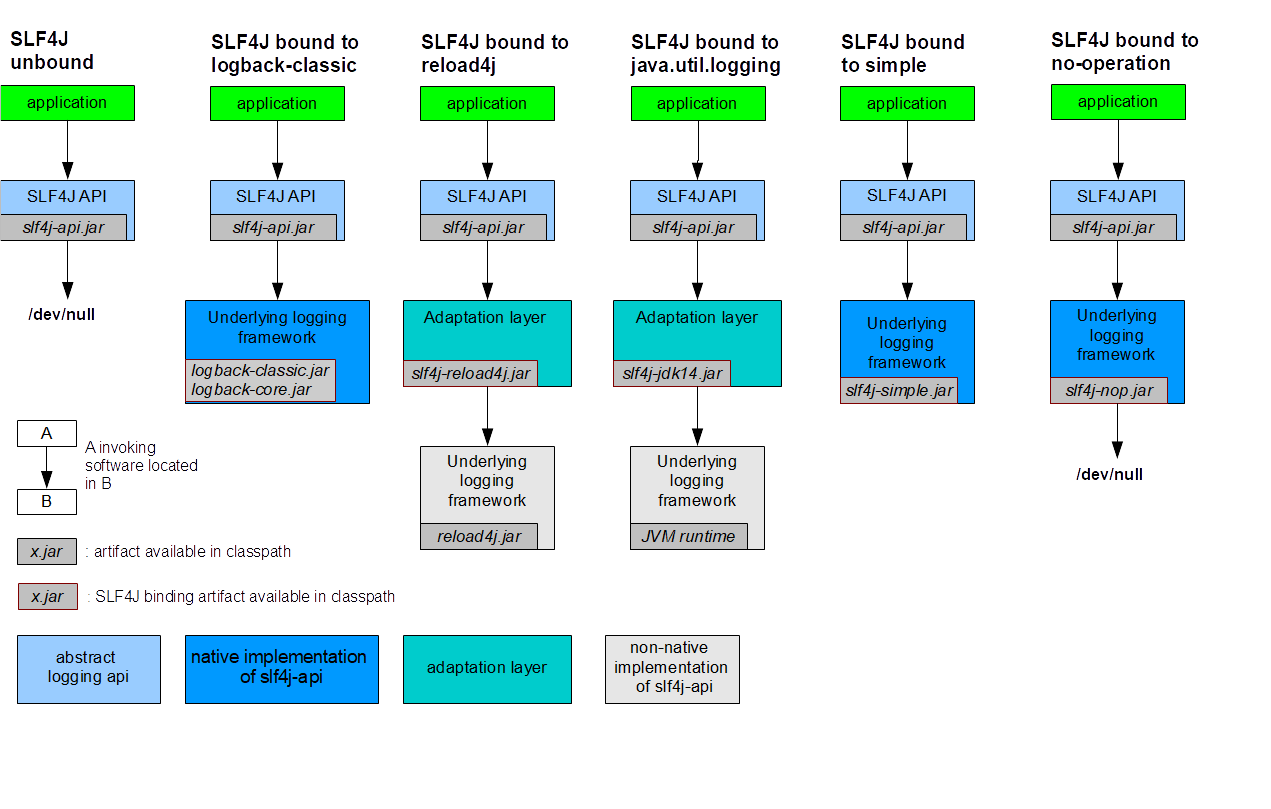
- https://www.slf4j.org/images/concrete-bindings.png