




Enterprise-grade multi-cloud FinOps automation toolkit for cost optimization across GCP and AWS.
| Solution | What it does | Cloud | Notification |
|---|---|---|---|
| GCP FinOps Guardian | Scans for cost optimization recommendations via Recommender API | GCP | Slack |
| AWS Resource Cleanup | Identifies and removes unused resources across regions | AWS | SES Email |
Serverless solution that periodically checks for GCP recommendations using the Recommender API and delivers Slack alerts about cost savings. Supports both organization-level and project-level scanning.
| Feature | Detail |
|---|---|
| Runtime | Python 3.12 on Cloud Functions |
| Memory / Timeout | 512 MB / 300 s |
| Trigger | Cloud Scheduler → Pub/Sub → Cloud Function |
| Notifications | Slack (direct webhook or via Secret Manager) |
| Recommenders | 10 types, individually toggleable |
| IaC | Terraform (Google provider ~> 5.0) |
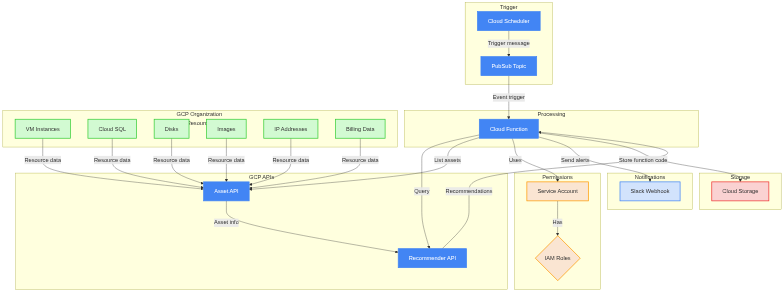
Components: Cloud Scheduler → Pub/Sub → Cloud Function → Recommender API → Slack
| Component | Purpose |
|---|---|
| Cloud Function | Runs recommendation checks (Python 3.12, factory pattern) |
| Cloud Scheduler + Pub/Sub | Triggers on configurable cron schedule |
| Service Account + IAM | Org-level or project-level least-privilege access |
| Cloud Storage | Versioned bucket for function code archives |
| Secret Manager (optional) | Secure storage for Slack webhook URL |
All 10 are enabled by default and individually toggleable via environment variables.
| Category | Recommender ID | Detects |
|---|---|---|
| Idle Resources | google.compute.instance.IdleResourceRecommender |
Idle VM instances |
google.compute.disk.IdleResourceRecommender |
Idle persistent disks | |
google.compute.image.IdleResourceRecommender |
Unused custom images | |
google.compute.address.IdleResourceRecommender |
Idle static IP addresses | |
google.cloudsql.instance.IdleRecommender |
Idle Cloud SQL instances | |
| Right-Sizing | google.compute.instance.MachineTypeRecommender |
VM instance right-sizing |
google.compute.instanceGroupManager.MachineTypeRecommender |
MIG machine type optimization | |
google.cloudsql.instance.OverprovisionedRecommender |
Cloud SQL right-sizing | |
| Cost Optimization | google.compute.commitment.UsageCommitmentRecommender |
Usage-based CUD recommendations |
google.cloudbilling.commitment.SpendBasedCommitmentRecommender |
Spend-based cost savings |
Required Variables
| Variable | Description | Default |
|---|---|---|
GCP_PROJECT |
Project where function is deployed | (required) |
SCAN_SCOPE |
"organization" or "project" |
"project" |
ORGANIZATION_ID |
GCP Org ID (required if scope = organization) | "" |
SLACK_HOOK_URL |
Slack webhook URL (if not using Secret Manager) | (required) |
Optional Variables
| Variable | Description | Default |
|---|---|---|
MIN_COST_THRESHOLD |
Skip recommendations below this USD value | 0 |
USE_SECRET_MANAGER |
Use Secret Manager for webhook | "false" |
SLACK_WEBHOOK_SECRET_NAME |
Secret Manager resource name | "" |
Recommender Toggles (all default to true)
| Variable | Resource |
|---|---|
IDLE_VM_RECOMMENDER_ENABLED |
VM instances |
IDLE_DISK_RECOMMENDER_ENABLED |
Persistent disks |
IDLE_IMAGE_RECOMMENDER_ENABLED |
Custom images |
IDLE_IP_RECOMMENDER_ENABLED |
Static IPs |
IDLE_SQL_RECOMMENDER_ENABLED |
Cloud SQL instances |
RIGHTSIZE_VM_RECOMMENDER_ENABLED |
VM right-sizing |
RIGHTSIZE_SQL_RECOMMENDER_ENABLED |
Cloud SQL right-sizing |
MIG_RIGHTSIZE_RECOMMENDER_ENABLED |
MIG machine types |
COMMITMENT_USE_RECOMMENDER_ENABLED |
CUD usage |
BILLING_USE_RECOMMENDER_ENABLED |
Billing optimization |
IAM Roles (automatically assigned by Terraform)
| Role | Purpose |
|---|---|
roles/cloudasset.viewer |
Asset inventory access |
roles/recommender.computeViewer |
Compute recommendations |
roles/recommender.cloudsqlViewer |
Cloud SQL recommendations |
roles/recommender.cloudAssetInsightsViewer |
Asset insights |
roles/recommender.billingAccountCudViewer |
Billing CUD recommendations |
roles/recommender.ucsViewer |
Unattended project recommendations |
roles/recommender.projectCudViewer |
Project-level CUD recommendations |
roles/storage.objectCreator |
Function code storage |
Required APIs (auto-enabled): Cloud Asset, Cloud Build, Cloud Functions, Cloud Scheduler, Recommender, Service Usage, Cloud Resource Manager, Secret Manager, Pub/Sub
Project-level scanning:
# terraform.tfvars
gcp_project        = "your-project-id"
gcp_region         = "us-central1"
recommender_bucket = "your-project-recommender"
scan_scope         = "project"
slack_webhook_url  = "https://hooks.slack.com/services/YOUR/WEBHOOK/URL"
job_schedule       = "0 0 * * *"   # daily at midnight
job_timezone       = "America/New_York"
Organization-level scanning — add:
scan_scope      = "organization"
organization_id = "123456789012"
cd gcp-finops && terraform init && terraform plan && terraform applyDeployed Resources
- Service Account with IAM roles (org or project level)
- Cloud Storage bucket (versioned, lifecycle-managed)
- Cloud Function (Python 3.12, 512 MB)
- Pub/Sub topic + Cloud Scheduler job
- Secret Manager resources (if enabled)
- All required API enablements
Slack Notification Format
Each message includes: GCP Project ID, recommendation type, recommended action, description, cost savings (with currency), and projection duration.
Automated multi-region resource cleanup with dry-run safety, tag-based preservation, and comprehensive email reporting.
| Feature | Detail |
|---|---|
| Runtime | Python 3.12 on Lambda |
| Timeout | 300 s (configurable) |
| Trigger | EventBridge (configurable CRON) |
| Notifications | SES email reports |
| Resources | 11 resource types across all regions |
| IaC | Terraform (AWS provider ~> 5.0) |
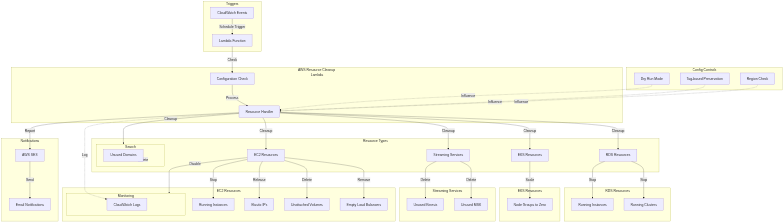
Components: EventBridge → Lambda → (EC2, RDS, EKS, ...) → SES Email Report
| Component | Purpose |
|---|---|
| Lambda Function | Thread-safe resource cleanup with retry & paginators |
| EventBridge | Scheduled trigger (configurable CRON) |
| CloudWatch Alarms | Error, throttle, duration, DLQ monitoring |
| SQS Dead Letter Queue | Encrypted queue for failed invocations |
| SES | Email reports (configurable region) |
| IAM | Least-privilege, per-service granular permissions |
| Resource | Action | Protection | Concurrency |
|---|---|---|---|
| EC2 Instances | Stop | Tag + Spot exclusion | Sequential |
| EC2 Monitoring | Disable detailed monitoring | - | Sequential |
| Elastic IPs | Release unassociated | Tag | Sequential |
| EBS Volumes | Delete unattached | Tag + EKS cluster check | Sequential |
| Classic ELBs | Delete empty | Tag | Sequential |
| RDS Instances & Clusters | Stop (available only) | - | Threaded |
| EKS Node Groups | Scale to zero | - | Threaded |
| Kinesis Streams | Delete (upsolver_* preserved) |
Prefix | Threaded |
| MSK Clusters | Delete (ACTIVE only) | State filter | Threaded |
| OpenSearch Domains | Delete (idle only) | State filter | Threaded |
| Resource Tags | Add CreatedOn |
- | Threaded |
Safety: All operations default to dry-run mode. Set
DRY_RUN=falseto perform actual changes.
Environment Variables
| Variable | Description | Default |
|---|---|---|
DRY_RUN |
"true" for dry-run, "false" for actual deletions |
"true" |
CHECK_ALL_REGIONS |
Scan all enabled AWS regions | "false" |
KEEP_TAG_KEY |
Tag key for resource preservation | "auto-deletion" |
KEEP_TAG_VALUE |
Tag value for resource preservation | "skip-resource" |
EMAIL_IDENTITY |
SES verified sender email | (required) |
TO_ADDRESS |
Recipient email address | (required) |
SES_REGION |
AWS region where SES identity is verified | "us-east-1" |
Default Regions (when CHECK_ALL_REGIONS=false)
us-east-1, us-east-2, us-west-1, us-west-2, eu-north-1, eu-central-1, eu-west-1
# terraform.tfvars
function_name     = "aws-resource-cleanup"
dry_run           = true
check_all_regions = false
keep_tag_key      = { "auto-deletion" = "skip-resource" }
email_identity    = "your-sender@domain.com"
to_address        = "your-recipient@domain.com"
ses_region        = "us-east-1"
event_cron        = "cron(0 23 * * ? *)"    # 11 PM UTC
sns_topic_arn     = ""                       # optional: SNS ARN for alarm notifications
cd aws-finops && terraform init && terraform plan && terraform applyDeployed Resources
- Lambda function (Python 3.12) with least-privilege IAM
- EventBridge rule for scheduling
- Encrypted SQS Dead Letter Queue
- 6 CloudWatch alarms (with optional SNS)
- SES email identity verification
| Alarm | Metric | Threshold |
|---|---|---|
| Errors | AWS/Lambda Errors |
> 0 |
| Throttles | AWS/Lambda Throttles |
> 0 |
| Duration | AWS/Lambda Duration |
> 90% of timeout |
| Concurrent Executions | AWS/Lambda ConcurrentExecutions |
> 50 |
| DLQ Delivery Failures | AWS/Lambda DeadLetterErrors |
> 0 |
| DLQ Messages | AWS/SQS ApproximateNumberOfMessagesVisible |
> 0 |
All alarms support optional SNS notifications via the sns_topic_arn variable.
Email reports include: deleted/stopped resources, skipped resources (dry-run or tagged), failed operations, and resources needing attention.
| Capability | GCP FinOps Guardian | AWS Resource Cleanup |
|---|---|---|
| Runtime | Python 3.12 / Cloud Functions | Python 3.12 / Lambda |
| IaC | Terraform (Google ~> 5.0) | Terraform (AWS ~> 5.0) |
| Trigger | Cloud Scheduler + Pub/Sub | EventBridge CRON |
| Notifications | Slack (webhook / Secret Manager) | SES email reports |
| Scope | 10 recommender types | 11 resource cleanup types |
| Concurrency | Sequential per asset | ThreadPoolExecutor (5 workers) |
| Safety | Cost threshold filtering, per-recommender toggles | Dry-run mode, tag-based preservation, state filtering |
| Credentials | Optional Secret Manager | Configurable SES region |
| Monitoring | Cloud Logging + Slack | CloudWatch Alarms + optional SNS + DLQ |
| IAM | Least-privilege org/project roles | Least-privilege per-service policies |
| GCP | AWS | |
|---|---|---|
| Account | GCP Organization or Project | AWS Account |
| Terraform | >= 1.3 (Google provider ~> 5.0) | >= 1.3 (AWS provider ~> 5.0) |
| Python | 3.12 | 3.12 |
| Notification | Slack webhook URL | SES verified email identity |
# GCP
cd gcp-finops && terraform init && terraform apply

# AWS
cd aws-finops && terraform init && terraform apply| Area | Guidelines |
|---|---|
| GCP | Follow factory pattern for new recommenders, maintain 80%+ test coverage, use structured logging |
| AWS | Test in dry-run mode first, follow modular function patterns, add error handling |
| Both | Update documentation, follow existing code patterns |
Adding a new GCP recommender:
- Create class extending
Recommenderinlocalpackage/recommender/compute/orcloudsql/ - Register in
factory.py - Add Terraform variable in
variables.tf+ env var inmain.tf
MIT License. See LICENSE for details.
Issues & Support: Open a GitHub issue with environment details and redacted logs.
