


PyPI package: smartmcp-router (CLI: smartmcp)
Intelligent MCP tool routing that reduces context bloat by serving only the tools your AI actually needs.
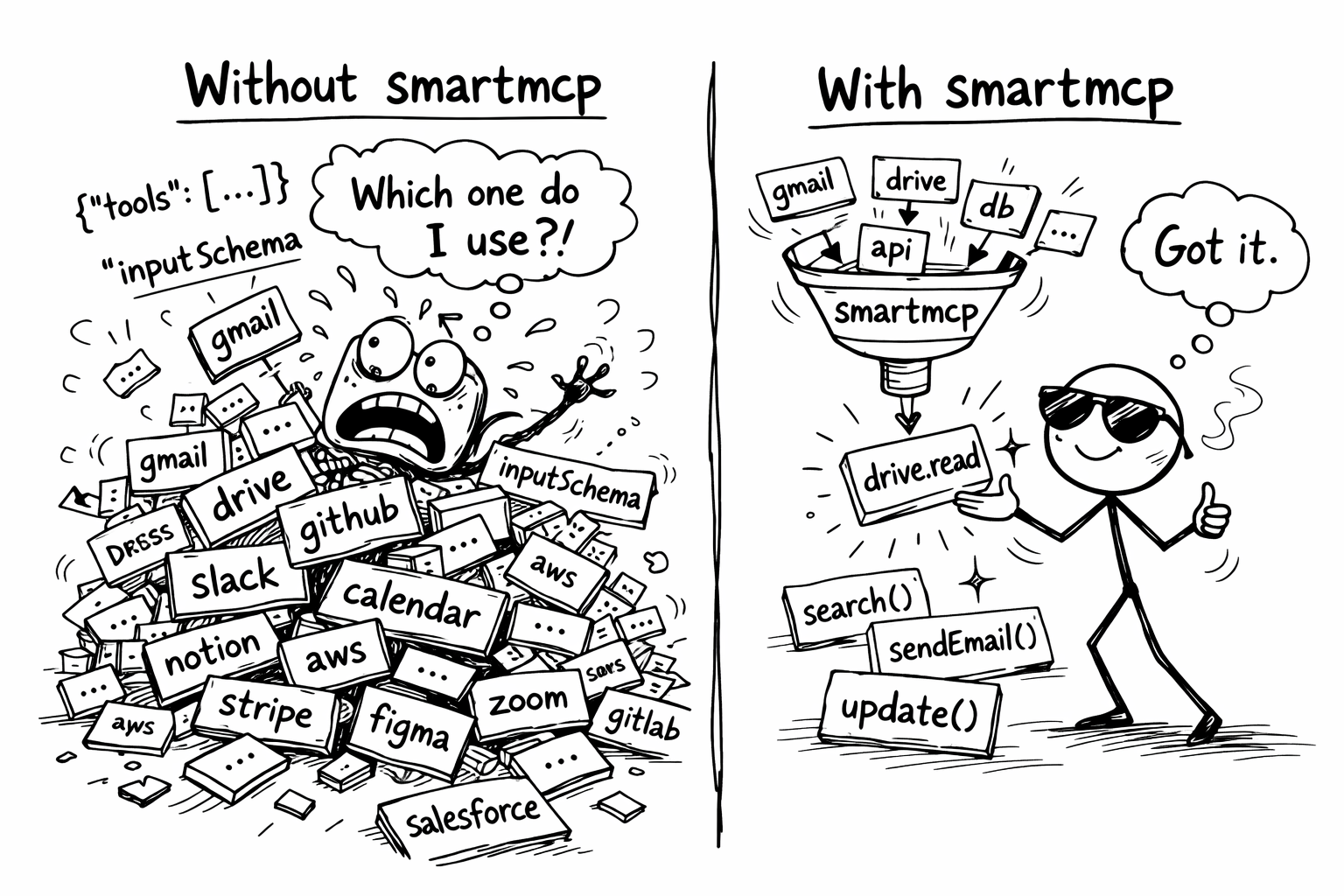
In my own setup with 8 MCP servers and 224 tools, every AI request was loading ~66,000 tokens of tool schemas before the model even started thinking. With smartmcp, that dropped to ~1,600 tokens. A 97% reduction on every request.
| Without smartmcp | With smartmcp | |
|---|---|---|
| Tools in context | All 224 | 1 (search_tools) + 5 matched |
| Tokens per request | ~66,000 | ~1,600 |
| Scales with | Every tool you add (O(n)) | Always top-k (O(1)) |
Token counts estimated at ~4 characters per token. Actual counts vary by model tokenizer.
Most MCP setups expose every tool from every server to the AI at once. With 5+ servers, that's 50–200+ tool schemas crammed into the context window before the AI even starts thinking. smartmcp fixes this.
smartmcp is a proxy MCP server that sits between your AI client and your upstream MCP servers. It indexes all available tools using semantic embeddings, then exposes a single search_tools tool. When the AI describes what it wants to do, smartmcp finds the most relevant tools and dynamically surfaces their full schemas so the AI can see their parameters and call them directly.
AI Client (Claude Desktop / Cursor / your agent)
    ↕  stdio
smartmcp (proxy server)
    ↕  stdio (one connection per server)
[github] [filesystem] [google-workspace] [git] [memory] [puppeteer] ...
smartmcp uses a two-phase flow: discover, then call.
- On startup, smartmcp connects to all your configured MCP servers, collects every tool schema, and builds a FAISS vector index using sentence-transformer embeddings.
- The AI sees only one tool:
search_tools. It calls it with a natural language query, for examplesearch_tools({ "query": "create a GitHub issue" }). - smartmcp runs semantic search across all indexed tools and finds the top-k matches.
- The full schemas of those matching tools (name, description, parameters, types) are dynamically added to the tool list. smartmcp sends a
tool_list_changednotification so the AI client re-fetches and sees them.
- The AI now sees the surfaced tool schemas with their complete
inputSchema. It picks the right tool, constructs the correct arguments itself, and calls it. - smartmcp parses the namespaced tool name (e.g.
github__create_issue), routes the call to the correct upstream server, and returns the result.
The intelligence is in the discovery step. The AI still does its own parameter construction based on the exposed schemas. smartmcp just narrows down which tools it sees.
pip install smartmcp-routerRequires Python 3.10+.
Create a smartmcp.json with your upstream MCP servers (same format as Claude Desktop / Cursor config):
{
  "mcpServers": {
    "filesystem": {
      "command": "npx",
      "args": ["-y", "@modelcontextprotocol/server-filesystem", "/home/user/documents"]
    },
    "github": {
      "command": "npx",
      "args": ["-y", "@modelcontextprotocol/server-github"],
      "env": {
        "GITHUB_TOKEN": "ghp_your_token_here"
      }
    },
    "slack": {
      "command": "npx",
      "args": ["-y", "@modelcontextprotocol/server-slack"],
      "env": {
        "SLACK_BOT_TOKEN": "xoxb-your-token-here"
      }
    }
  },
  "top_k": 5,
  "embedding_model": "all-MiniLM-L6-v2"
}Add smartmcp as your single MCP server entry. It now manages all your upstream servers defined in smartmcp.json.
Add to your claude_desktop_config.json:
{
  "mcpServers": {
    "smartmcp": {
      "command": "smartmcp",
      "args": ["--config", "/path/to/smartmcp.json"]
    }
  }
}Add to your .cursor/mcp.json:
{
  "mcpServers": {
    "smartmcp": {
      "command": "smartmcp",
      "args": ["--config", "/path/to/smartmcp.json"]
    }
  }
}Point your MCP client at smartmcp the same way you would any stdio MCP server:
smartmcp --config /path/to/smartmcp.jsonYour AI now sees a single search_tools tool. When it needs to do something, it searches:
AI calls:
search_tools({ "query": "read files from disk" })smartmcp returns: 3 matching tools from the filesystem server. Their full schemas are now exposed.
AI sees: The complete parameter definitions for
filesystem__read_file,filesystem__list_directory, etc. It picks the right one, fills in the arguments, and calls it.smartmcp proxies the call to the filesystem server and returns the result.
| Field | Type | Default | Description |
|---|---|---|---|
mcpServers |
object | (required) | Map of server names to MCP server configs |
mcpServers.<name>.command |
string | (required) | Command to spawn the server |
mcpServers.<name>.args |
string[] | [] |
Arguments for the command |
mcpServers.<name>.env |
object | {} |
Environment variables for the server |
top_k |
integer | 5 |
Default number of tools returned per search |
embedding_model |
string | "all-MiniLM-L6-v2" |
Sentence-transformers model for embeddings |
- Less context waste: Instead of 100 tool schemas in every request, the AI sees 1 tool plus only the few it actually needs.
- Better tool selection: Semantic search finds the right tools even when the AI doesn't know the exact name.
- Full schema exposure: Surfaced tools include their complete parameter definitions, so the AI constructs calls correctly.
- Works with any MCP server: If it speaks MCP over stdio, smartmcp can proxy it.
- Drop-in replacement: Replace your list of MCP servers with one smartmcp entry. No code changes needed.
- Graceful degradation: If some upstream servers fail to connect, smartmcp continues with whatever is available.
smartmcp is early-stage and actively improving. Contributions are welcome, especially around search accuracy, embedding strategies, and support for new transports.
If you have ideas, find bugs, or want to add features, open an issue or submit a PR on GitHub.